
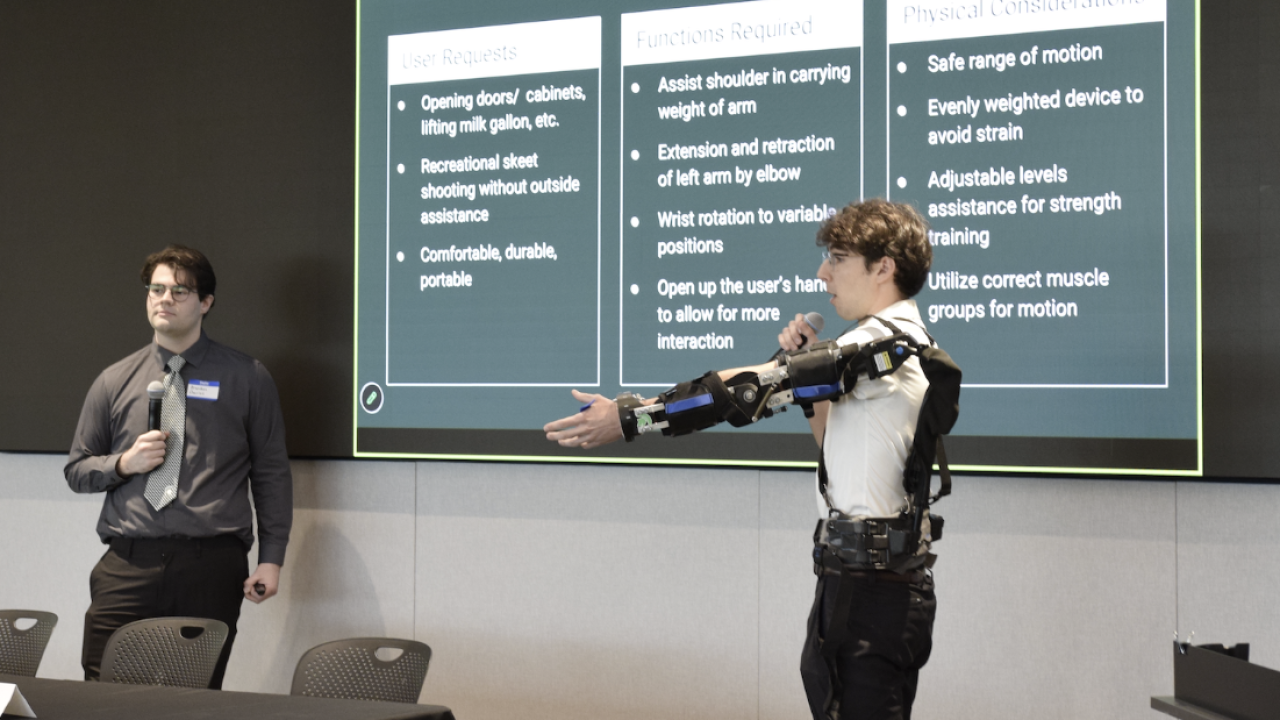
At the Michigan State University (MSU) AgeAlive Education and Research Forum, a group of engineering students showed how a simple idea could change someone’s life.
The 2025 MSU Student Capstone Team #9 — Brandon Davies and Brody Stack — presented a device designed to help individuals regain arm mobility after injury. Their work builds on research from Professor Rajiv Ranganathan, Ph.D., associate professor in the MSU Department of Kinesiology, whose studies focus on using ‘residual movement’—the small movements people retain—to support recovery. Additional team members Finn Jarvis, Damon McConnell, and Miles Hayes also contributed to the project.
“Disability often alters movement, reducing strength and range of motion — yet meaningful residual capacity frequently remains,” Ranganathan said.
The students took that idea and turned it into a real product. “We had the pleasure of designing a device taking remaining mobility, or what is left after an accident, and making something that is personalized yet adaptable,” Davies said.
The team worked with a fellow MSU student who had a brain injury. The injury made it hard for him to lift his left arm or reach across his body. “He has trouble reaching and lifting his arm up to shoulder height,” Stack said. “He needs help to do that.”
Their goal was simple: help him do everyday tasks again.
“The goal was to design something easy to take on and off, to assist him with everyday tasks like opening doors, grabbing a glass of water, just normal everyday tasks,” Stack said. The result was a wearable arm support device. It uses springs and adjustable parts to help lift and guide the arm.
“If I were to push down, it kind of pushes back up,” Davies explained. “This is all using mechanical springs, it can be adjustable depending on the person.”
The device is also designed to grow with the user. “As you gain strength in your shoulder, you can use much larger settings,” he said.
Comfort was another key focus. The team added soft materials and padding to make the device easier to wear for long periods. “We used medical foam coated with sheepskin padding to help with abrasion,” Davies said.
Everything on the device can be adjusted. “In every point, we are designing for adaptability,” Davies said. “You can adjust it with just a screwdriver, if not just your fingers.”
One of the most important moments came when the team tested the device with the student. “This is one of the first times he’s been able to do that independently,” Davies said, describing how the user could extend his arm away from his body.
His physical therapist was excited, too. “The PT is pretty excited about it,” Davies said.
He explained that the device could also help with rehab by slowly improving movement over time. “It might be like one step at a time,” he said. “But you can start here and then do exercises that help move that out.”
The project quickly became more than just an assignment. “Once we really got to meet him, it became very personal,” Stack said. “It was just such an awesome project to see the smile on his face.”
The students said they spent hours thinking about the design — even outside of class. “It was never off,” Stack said. “It was always in the mind.”
The device was also designed for more than just one person. The team worked with AgrAbility, a group that helps people in agriculture.
“We wanted to make our device also be able to be used in an agricultural field,” Stack said. “For picking fruit, trimming trees, repetitive tasks.”
In the end, the project shows how engineering and caregiving can come together.
At the 2026 MSU AgeAlive Education and Research Forum — which focuses on “advancing mobility across settings as we age” — the students’ work stood out as a real-world solution. By turning small movements into big progress, the team helped show that recovery is possible — one step at a time.
Events like AgeAlive are important because they bring together students, researchers, and the community to solve real problems. The forum highlights new ideas that can improve daily life, especially for older adults and people with limited mobility. Participants get a peek at ground-breaking advancements in health care led by MSU faculty, staff, and students as well as leading health and human service groups. By sharing projects like this, AgeAlive helps turn research into action — and shows how small innovations can make a big difference in people’s independence and quality of life.
To learn more aging-related research, visit Research – AgeAlive.