
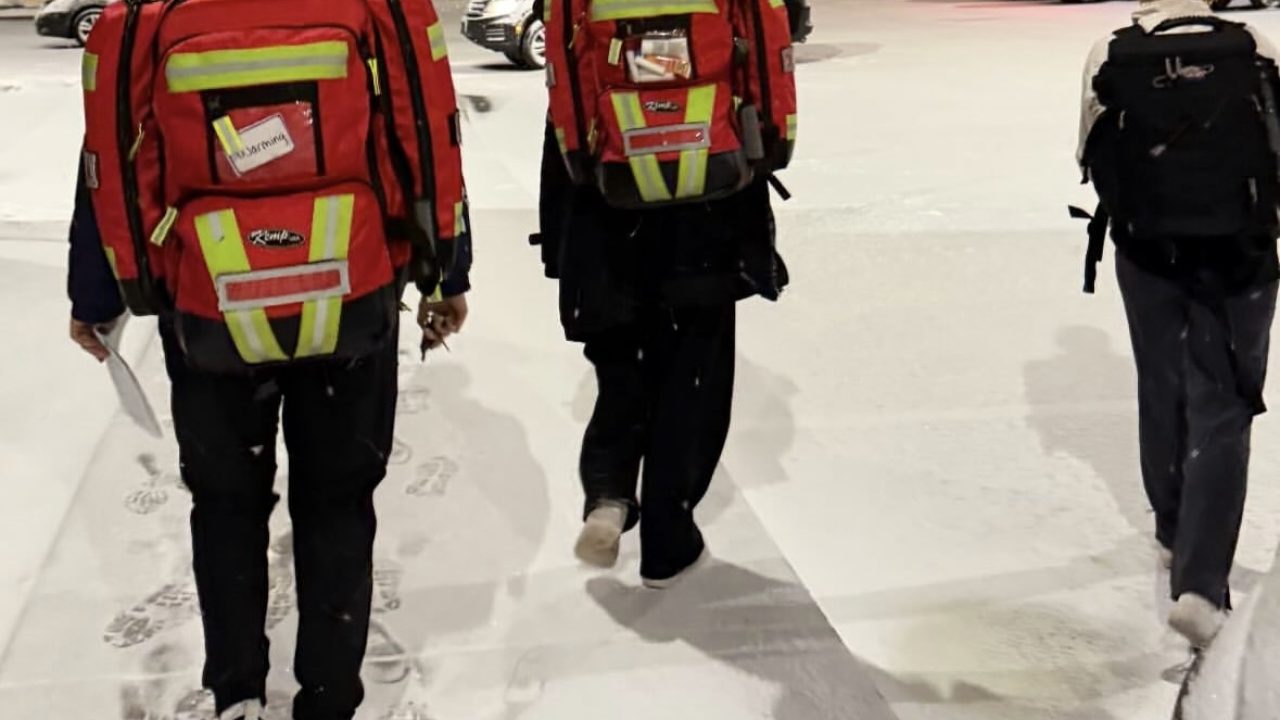
A recent MSU AgeAlive Town & Gown session at Michigan State University brought together students, physicians, and community members to discuss how to better care for people experiencing homelessness. The program, Spartan Street Medicine, focused on a simple but powerful idea: bringing health care directly to people who cannot easily get to clinics or hospitals.
The session featured presentations from Graham Atkin, Ph.D., an associate professor in MSU’s Division of Human Anatomy, and Sophia Bair, an MSU medical student from the MSU College of Osteopathic Medicine and one of the student coordinators for Spartan Street Medicine.
Atkin opened the talk by saying, “Zero percent of this talk is intended to convince you to care about people in need. I know you care about people in need.”
He explained that the goal was not to persuade people to care, but to show what the program actually does in the community.
He shared a story about a man he called, “Steve,” who became unhoused after medical and job challenges. Steve and his wife were living under a bridge. “No one intends to be living under a bridge with their wife,” Atkin said.
He explained that Steve got a hand infection from a dog bite but could not easily get treatment. “He doesn’t have transportation, he doesn’t have antibiotics, and he doesn’t have Band-Aids,” Atkin said.
Atkin also explained how serious homelessness can be for health. “If you are unsheltered, you are 10 times as likely to die as someone who is housed,” he said. Even in shelters, he added, “you’re still three times as likely to die.”
He said one of the biggest problems is access to care. “The ER is often gone to because it’s accessible. That doesn’t mean it’s the health care they need,” he said. “They need primary care. They need an ongoing relationship with a doctor.”
Bair, a second-year osteopathic medical student at the MSU College of Osteopathic Medicine and one of the program’s student leaders, spoke about what it is like to be part of the team. “We go to the people,” she said. “That’s not just a nice idea. That’s really what we do.”
She described the work as both challenging and meaningful. “Sometimes that’s in the woods in the middle of December, and you’re trudging along, and it’s snowy and gross,” she said. “And then you remember what it’s like to live there.”
Bair said the program is built on respect for patients. “This is really about restoring patient autonomy,” she explained. “The least we can do is say, ‘you are in control of this visit.’”
She also shared how emotional the work can be. “I can’t tell you how many times people have just wept in my arms,” she said. “There’s something so beautiful about using your hands to heal.”
Later in the session, MSU alumnus Kent Workman talked about why he attended the program and why it matters. “The topic, particularly the street medicine topic,” he said, is what brought him there. He added that he had attended several Town & Gown events before.
When asked why programs like Spartan Street Medicine matter, Workman said, “The part of the community that’s unserved is being served.” He also said, “A lot of people want to help, but they don’t know how to help the unhoused.”
He emphasized the value for students as well. “That person-to-person contact… gives them practical experience,” he said. “We will create doctors who are more compassionate and more caring.”
Workman also reflected on what he learned. “I learned what they are specifically doing,” he said. “It hasn’t changed my opinion that we need to be doing much more as a society.”
Throughout the session, speakers returned to the same idea: care must go where people are. “If we can’t get the patient to the doctor, we bring the doctor to the patient,” Atkin said.
Bair added a simple message that summed up the program’s approach: “Small things with great love.”
To learn more or support Spart Street Medicine programming, visit Spartan Street Medicine | MSU Osteopathic Medicine.