
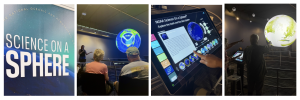
 Community members gathered at the MSU Museum on Friday, July 17, for an MSU AgeAlive Town & Gown session that transformed scientific data into an immersive learning experience through Science on a Sphere. Hosted through a partnership between the MSU Museum and several MSU and community organizations, this was the first Town & Gown session held as a special tour on the MSU campus. The Town & Gown Series is an MSU AgeAlive program within the College of Osteopathic Medicine, presented in partnership with the MSU Social Science Scholars Program, Generations Connect, the East Lansing Prime Time Seniors Program, The Great Decisions Program of the Foreign Policy Association, and The Peoples Church of East Lansing.
The interactive tour brought participants to Science on Sphere, an interactive exhibit developed by the National Oceanic and Atmospheric Administration (NOAA) that projects scientific data onto a six-foot suspended globe. Led by MSU Museum educator and Science on a Sphere coordinator, Carrie Wicker, the presentation guided visitors through hundreds of interactive datasets, showcasing everything from earthquakes and climate change to wildlife migration and space exploration.
Wicker explained that Science on a Sphere was created to bridge the gap between scientific research and public understanding.
“There was all this really wonderful research data and information coming out of NOAA, but there really was kind of a disconnect between the development of all of this data and communicating that data to the public,” Wicker said. “The idea of Science on a Sphere was to put all of this stuff into places where people like myself and other educators and communicators can use it for teaching and learning.”
Throughout the presentation, Wicker demonstrated how the sphere can display more than 800 datasets, allowing visitors to watch a century of earthquakes unfold, visualize global air traffic, track sea turtle migrations and compare the true size of continents without the distortions of a traditional flat map.
“The particular strength of Science on a Sphere is that we can look at this incredibly high volume of data in the course of a minute and a half, and it’s really easy to see patterns,” Wicker said. “It’s really easy to extrapolate meaning from data in this incredibly visual way.”
Wicker said the technology makes complex scientific concepts easier to understand by turning abstract information into an interactive, visual experience.
“If I was a geologist and I was trying to talk to undergraduate students, I could verbally tell students that earthquakes are the result of the movement of plate tectonics,” Wicker said. “But if we teach them that concept here in the Science on a Sphere space, it just makes that idea more real, more visual and hopefully easier for students to remember.”
Unlike traditional museum exhibits, Science on a Sphere encourages visitors to choose the topics that interest them most, creating a personalized learning experience.
“Visitors tend to spend a lot of time in this gallery because they’re able to self-select what they think is interesting,” Wicker said. “You walk into a lot of exhibitions and what you see is what you get. With Science on a Sphere, people can look at different categories and pick what’s interesting to them.”
The technology also serves as a teaching tool for Michigan State students. Wicker said faculty members regularly partner with the museum, giving students the opportunity to create their own visualizations that are later displayed on the sphere.
“I think students always find it particularly exciting to be able to see the content that they made put up in the museum exhibit,” Wicker said. “There’s something about doing it in the museum and on a more unique platform like this that just makes it more interesting and engaging.”
For first-time attendee Ginger Petty, the presentation offered a new way to experience science.
“I loved it,” Petty said.
She said seeing information projected onto the globe made scientific concepts easier to understand.
“Everybody learns differently, and for some people, this is the very best way to learn instead of reading,” Petty said. “So I think it’s important to have different methods of education.”
Returning attendee Michael Nation said the interactive format offered a perspective that a traditional presentation simply cannot provide.
“The whole idea of presenting information this way was a great idea,” Nation said. “You can show something three-dimensional on a computer, but here you can walk around it.”
Nation said exhibits like Science on a Sphere also help strengthen the connection between Michigan State University and the surrounding community.
“I think innovations like this are great, and getting the public in here is good too,” Nation said.
As the presentation wrapped up, many attendees remained in the gallery, rotating the sphere through different datasets, asking questions and discussing what they had learned. Nation said the exhibit inspired a sense of wonder among visitors, recalling comments he heard throughout the event.
“One thing about being older, this would’ve been considered magical back in the day,” Nation said, recalling one attendee’s reaction.
He summed up the experience just as simply, “I can stay here for hours,” Nation said.
The event reflected the mission of the Town & Gown Series, an MSU AgeAlive program that connects the university and the surrounding community through engaging educational experiences. By transforming complex scientific data into an interactive exhibit, Science on a Sphere offered visitors not only a new way to explore the world, but also a reminder that learning can happen far beyond the classroom.
Donate here: MSU Giving