
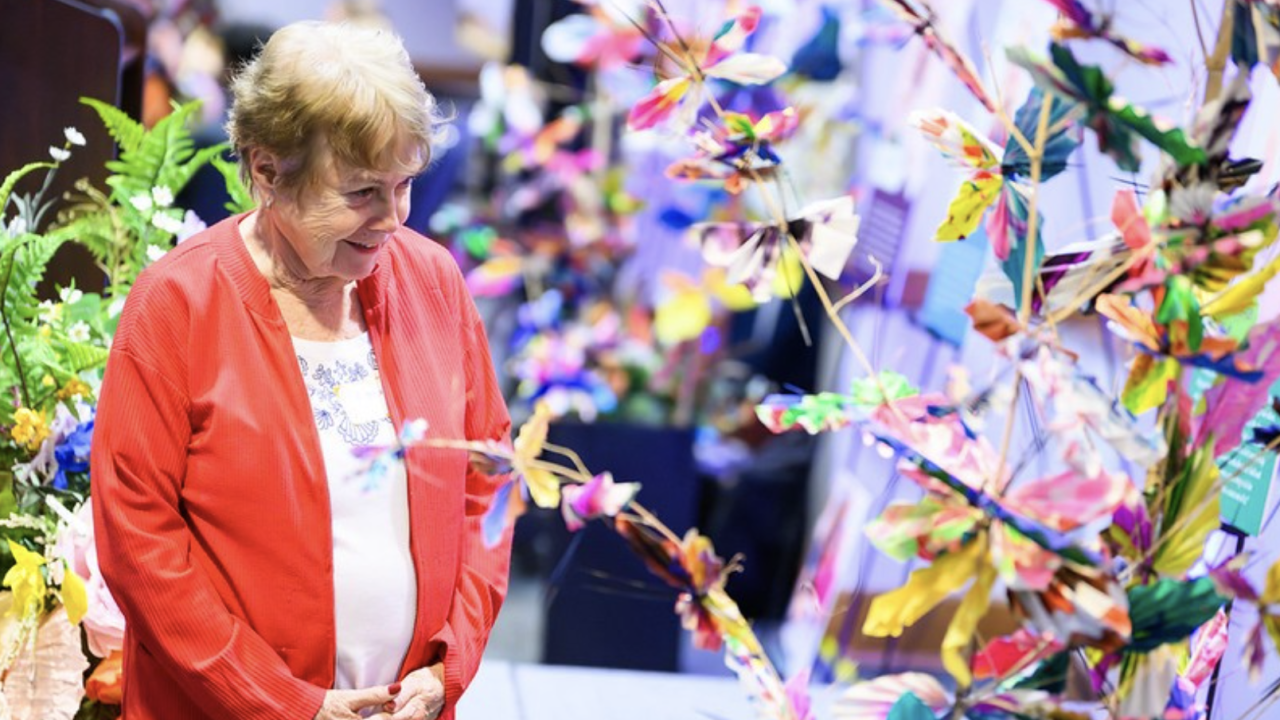
At Michigan State University, Artist-in-Residence Zahrah Resh is building something that looks delicate at first glance—paper butterflies, garden installations, quiet creative spaces—but carries the weight of illness, grief, healing, and human connection.
Her work with AgeAlive and IMPART Alliance did not begin as a formal university role. Instead, it started as a personal project that slowly grew into a community-centered practice built around one idea: art belongs to everyone.
“This is what I was meant to do,” she said. “Art is for everybody.”
She added, “People think art is a privileged thing, but I want people to realize that art is for everyone. It’s easy, it’s accessible, and it has a lot of health benefits.”
The health benefits, she said, include reduced stress and anxiety, improved mood, increased self-esteem and stronger memory and cognitive stimulation. But for Resh, the impact is also emotional and deeply personal.
“Art is a safe and healthy outlet for processing emotions and trauma,” she said.
The foundation of Resh’s current work began with what she calls the Butterfly Garden—a project she created before formally joining MSU AgeAlive. Then, the opportunity presented itself to collaborate with partners at MSU—her alma mater. Through the partnership, interest in her work grew and, with it, the impact.
“At first I said no because I like to work alone,” she said. “But then I said, let’s give it a try.”
With little to no funding in the early years, Resh built the Butterfly Garden pro bono, continuing the work for nearly three years before formal university support developed through AgeAlive and later IMPART Alliance. Through IMPART Alliance, she also helped develop “A Caregivers Butterfly Garden,” expanding the project’s focus on healing, reflection and support for caregivers across Michigan. Organizers hope the initiative will encourage more people to explore caregiving careers and seek quality training, helping address the state’s shortage of direct caregivers while also supporting those already in the profession.
“Clare approached me about using the butterfly garden concept to promote AgeAlive,” she said. “And I said, okay.” Clare Luz, PhD, is the MSU associate professor and founding director of MSU AgeAlive and IMPART Alliance.
Over time, that collaboration became the foundation for Resh’s role as artist-in-residence, where she now helps guide workshops, community engagement and creative programming. While some previous funding sources have ended, AgeAlive and IMPART Alliance continue to receive support through the Michigan Department of Health and Human Services (MDHHS), along with university partnerships, sponsorships and community donations that help sustain wellness and intergenerational programming initiatives. In recent years, the two organizations have continued working closely together through shared wellness, caregiving and intergenerational initiatives, further expanding the reach of Resh’s art programming.
Reflecting on why the work has become so important to her, Resh said her understanding of art shifted dramatically after a personal health crisis several years ago. She was diagnosed with thyroid cancer while continuing to work on creative projects.
“I had thyroid cancer,” she said. “When I was diagnosed, I was painting and doing an exhibit. I thought I might never paint again.”
Treatment left her exhausted and uncertain about her creative future.
“Your brain is kind of mush,” she said. “I couldn’t understand color anymore.”
But she eventually returned to her work after encouragement from a physician friend who urged her to submit her art and Butterfly Garden concept to a major exhibition in Grand Rapids
“I said no for a whole year,” she said. “Then he said, ‘I will find you a spot.’”
That opportunity led to one of the most significant Butterfly Garden installations of her career—at a cancer treatment facility in Grand Rapids.
At the cancer center, patients, caregivers and medical staff were invited to create paper butterflies that became part of a large public installation. Over the course of the project, participants folded more than 6,500 butterflies.
“They would come down with their IV of chemo and sit there while I built the garden,” she said.
Patients were encouraged to write messages on their butterflies, and some of those moments have stayed with her ever since.
A man in his 80s, terminally ill, had not told his wife the full extent of his diagnosis. While participating in the project, he wrote a message on a butterfly for her.
“I don’t know how to say goodbye to you,” he wrote.
Resh said the moment underscored what the project had become.
“It is very sad,” she said. “But if he didn’t hold that butterfly, she would never know.”
In another moment, a child struggling to understand his father’s illness chose a butterfly from the installation.
“He said, ‘Now I can go tell my dad that I found his ride to heaven,’” Resh recalled.
She paused, reflecting on the moment.
“What do you say to that?” she said.
“The whole thing is that art is more than winning a prize,” she said. “A simple paper butterfly changed everything.”
The installation became a place where patients, families and caregivers gathered—not just to create, but to openly talk about illness, fear and mortality in ways they often could not elsewhere.
“They don’t talk to each other about their illness,” she said. “But there, they do.”
She described one man who regularly visited during treatment and later told her the garden felt like a sanctuary.
“This is what I think heaven is like,” he told her.
That philosophy now informs Resh’s work with AgeAlive and IMPART Alliance, where she helps design programming focused on wellness, intergenerational connection and creativity.
She recently spoke to about 100 students about using art as a daily practice for mental health and connection.
“I told them it’s not about perfection,” she said. “It’s about excellence.”
She added that students were more responsive than expected. “They stayed the whole time,” she said. “They asked questions. They participated.”
Building on that mission, she is now helping shape a proposed AgeAlive and IMPART Alliance campus-wide project at MSU that would place small “satellite gardens” across campus, each centered around a different wellness theme.
One might ask students about friendship. Another might focus on creativity or self-care. Participants would engage through QR codes and contribute to a larger shared installation over time.
At the end of the year, the gardens would be brought together into one collective space.
For Resh, the work continues to circle back to the same idea that began with a single paper butterfly: art as connection.
“They feel seen,” she said. “They’re not invisible.”
And for her, that is the point.
“It’s not about me,” she said. “It’s about the people.”
Community members interested in supporting AgeAlive’s programming, research and intergenerational initiatives can contribute through Michigan State University’s online giving platform, with additional opportunities available through sponsorships and community partnerships.